
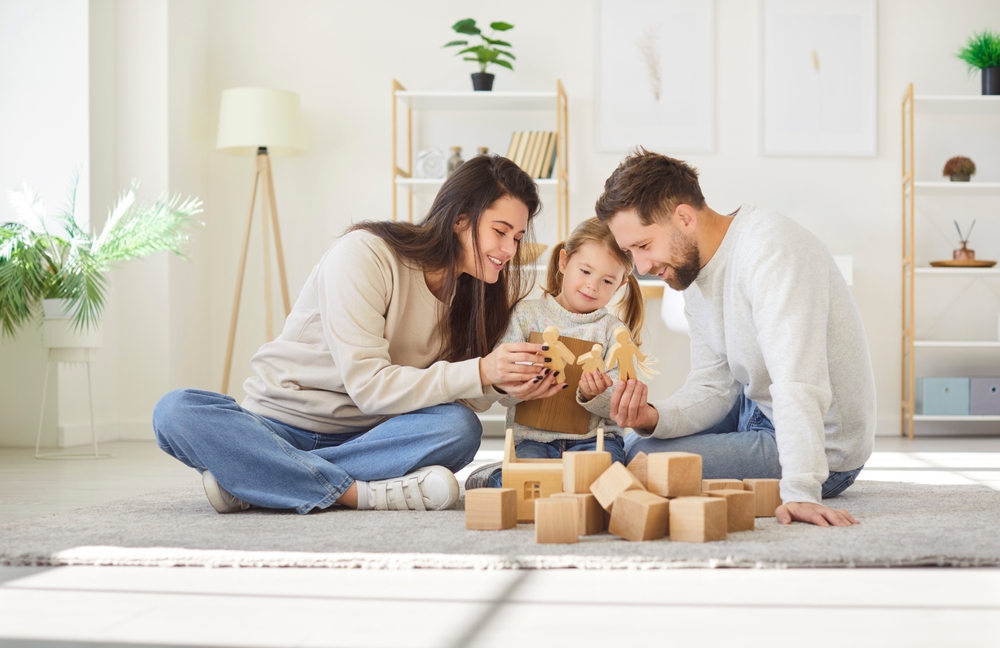
As parents, we often think about what we need to teach our children. We make lists in our heads: how to be kind, how to share, how to handle disappointment, how to be a good friend. We search for the right words and the perfect teachable moments. But what if the most powerful classroom for these life lessons is not in a conversation, but in the middle of the living room floor, surrounded by blocks and dolls?
Play is the natural rehearsal space of childhood. It is where children get to practice the complex art of being human in a low-stakes environment. Before they face the real-world challenges of a difficult friendship, a frustrating project, or a surprising change of plans, they get to try on these experiences in play. They learn how to regulate their bodies, understand others’ minds, and adapt when things don’t go their way. The benefits of play for emotional development are not about performance; they are about practice.
At Therapy & Play, we see play as the foundation for social and emotional well-being. It is how children learn the life skills that can’t be taught with flashcards. Understanding play as a form of emotional practice allows us to see our children’s messy, chaotic, and joyful explorations not just as fun, but as deeply important work.
Play Gives Children a Safe Place to Practice Life
Life is full of moments where we try, stumble, and get back up again. For adults, this process can feel high-stakes. But for children, play creates a safe container where this cycle can happen without fear of lasting failure. Why is play so important for child development? Because it provides a space to practice living.
In the world of play, a child can build a magnificent tower only to watch it crash to the ground. They can feel the sting of disappointment and then have the chance to start over. They can try to lead a game and have their friends reject their idea, giving them a chance to practice negotiation. Social emotional development through play is powerful because the consequences are temporary, but the learning is permanent.
Trying, Struggling, Recovering — All Within Safety
When a child learns to ride a bike, they fall. They scrape their knees. They get back on. We understand this as a necessary part of the process. The same is true for emotional skills. A child cannot learn resilience without experiencing a setback. They cannot learn to solve problems without first facing a problem.
Play provides a constant stream of manageable challenges. The puzzle piece won’t fit. The two dolls both want to wear the same dress. The blanket fort keeps collapsing. Each of these moments is a micro-opportunity to practice struggling and recovering. The child’s brain and nervous system learn, on a deep and cellular level, “This is hard, but I can handle it.”
Why Practice Matters More Than Perfection in Early Childhood
Our culture often puts pressure on children to perform—to get the right answer, to behave perfectly, to achieve the next milestone. But early childhood is not about performance; it is about process. A child’s developing brain needs countless repetitions to build strong neural pathways. It needs the freedom to get it “wrong” a hundred times before getting it “right.”
Play is inherently process-oriented. There is no final grade. There is no end goal, other than the exploration itself. This freedom from the pressure of perfection allows children to be brave. They can try a new role in a pretend game, attempt a difficult physical feat, or express a big, messy feeling without worrying about judgment. This is how genuine confidence is built—not from praise, but from the internal sense of competence that comes from trying.
Emotional Regulation Begins in Shared Experiences
One of the most important life skills is emotional regulation—the ability to manage our feelings and reactions. We often wish our children could just “calm down” when they are upset. But emotional regulation in early childhood is not a solo activity. It is a skill that is learned within the context of a safe relationship.
How children learn self regulation is by first “borrowing” it from a calm and attuned adult. This process is called co-regulation. When a child is overwhelmed, a parent’s steady presence, soothing voice, and gentle touch can help their agitated nervous system settle. Play provides a perfect, recurring opportunity for this to happen.
Borrowing Calm Before Finding It Within
Imagine a wrestling game with your child. The energy gets higher and higher, the giggles get louder, and then it tips into being just a little too wild. You, the parent, can pause the game and say, “Whoa, let’s take a deep breath together. My body is getting too excited.” In that moment, you are lending your child your prefrontal cortex—the part of your brain that can put on the brakes. You are co-regulating.
Through thousands of these shared experiences, the child’s brain starts to build its own capacity for regulation. They internalize your calm. The external support you provide becomes an internal skill they can access on their own. We don’t teach kids to manage emotions with charts or lectures; we model it with our own regulated presence.
How Play Helps the Nervous System Settle and Reset
Play naturally moves between states of high arousal and calm. A game of chase is followed by a moment of rest. A period of intense focus on building is followed by a gleeful crash. These rhythmic cycles are like a workout for the nervous system.
The nervous system learns to move between activation (the gas pedal) and settling (the brake pedal) with more ease. Physical play, in particular—like swinging, spinning, or deep pressure from a hug—can have a profoundly organizing effect. It gives the nervous system the input it needs to reset, helping a child move from a state of chaos or distress back to a state of balance.
Through Play, Children Learn to Understand Other Minds
Empathy—the ability to understand and share the feelings of another—is the foundation of kindness and connection. But it is not a skill we are born with. How children develop empathy is a gradual process of discovery, and play is their primary laboratory.
To feel empathy, you first have to realize that other people have thoughts and feelings that are different from your own. This is a huge cognitive leap, and it happens right in the middle of the playroom. Social skills through play emerge as children begin to practice perspective taking, trying on the experiences of others.
Pretend Play and Perspective-Taking
When a child pretends to be a firefighter, a doctor, or a baby, they are engaging in a sophisticated act of perspective-taking. They have to imagine: What would a baby want? How would a doctor feel? What would a firefighter do? This stretches their brain beyond their own immediate experience.
If they are playing “house” and their friend, playing the baby, starts to cry, they have to stop and think, “What does the baby need?” They might offer a bottle or a blanket. In that moment, they are practicing empathy. They are responding to the perceived emotional needs of another person. The more they practice this in play, the more natural it becomes in real life.
Discovering That Other People Have Feelings Too
Play with peers is a constant stream of social feedback. If a child snatches a toy, their friend might cry. This is a direct, real-time lesson in cause and effect: “My action caused a feeling in someone else.” While it may be an uncomfortable moment, it is an essential one for the development of empathy.
In a safe play environment, these moments aren’t seen as failures but as learning opportunities. The child learns that their friend’s face gives them clues about how they are feeling. They learn that certain actions lead to tears and others lead to laughter. This is how empathy development in toddlers begins—not through lectures about being nice, but through the lived experience of social interaction.
Flexibility Grows When Children Can Adapt in the Moment
Life rarely goes according to plan. The ability to adapt to unexpected changes, to pivot when things go wrong, and to see a problem from different angles is known as cognitive flexibility. This skill is a key component of resilience and is strongly linked to success in school and in life.
Cognitive flexibility in children is not something you can teach from a book. It is a muscle that gets strengthened through practice. Play is the ultimate gym for flexible thinking because it is, by nature, unpredictable.
When the Tower Falls Down
Every child who has ever played with blocks knows the experience. You are carefully building a magnificent tower, adding one block at a time. You are filled with pride and excitement. And then, it wobbles and comes crashing down.
In that moment, the child is faced with a choice. They can have a meltdown and give up, or they can take a deep breath and start again. Maybe this time, they will build a wider base. Maybe they will build something different altogether. This is problem solving for kids in its purest form. They are learning to cope with disappointment and adapt their plan. They are building resilience, one fallen tower at a time.
Learning That Plans Can Change — and That They Can Cope
In pretend play, the narrative is constantly shifting. One minute the cardboard box is a spaceship; the next minute, a friend declares it’s a pirate ship. The child has to be flexible enough to go with the new story.
This adaptable thinking in early childhood is a workout for the brain. It requires the child to let go of their own idea and incorporate someone else’s. It teaches them that there is more than one way to play the game, more than one right answer. This ability to mentally “shift gears” is crucial for navigating the social world and for creative problem-solving throughout life. Play teaches them, on a deep level, “My plan didn’t work out, and that’s okay. I can make a new one.”
Mistakes During Play Build Confidence, Not Shame
As a culture, we are often afraid of mistakes. We see them as failures. But in development, mistakes are simply data. They are information. Play is a space where mistakes are not only allowed, but expected. This is why it is so effective at building confidence in children.
When the stakes are low, children are willing to take healthy risks. They will try to jump from a slightly higher step or attempt a more complex Lego creation. If they fail, they haven’t disappointed anyone. There is no grade. There is no shame. There is only the opportunity to try again.
Why Low-Stakes Challenges Strengthen the Brain
Growth through mistakes is a core principle of child development. When a child tries something and it doesn’t work, their brain has to analyze the problem and generate a new solution. This process of trial and error is what forges new, stronger neural connections.
Resilience through play develops because the child experiences hundreds of these small cycles of challenge and mastery every day. They learn that effort pays off. They learn to trust their own ability to figure things out. This is a much deeper and more enduring form of confidence than that which comes from empty praise. It is an earned confidence, built from the inside out.
Encouraging Courage Without Pressure
Parents can foster this by resisting the urge to jump in and solve every problem for their child. If the puzzle piece isn’t fitting, let them struggle with it for a moment before offering help. If they are nervous about climbing the slide, offer your steady presence without pushing them.
Encouraging courage isn’t about eliminating fear; it is about supporting a child as they move through it. Your belief in their ability to handle a challenge is often all they need to try. By allowing for healthy risk taking in kids, we are communicating our trust in their competence.
Social Play Teaches Skills Children Carry Into School and Relationships
The transition to school is a huge step. While we often focus on academic readiness, social and emotional skills are far better predictors of a successful school experience. Kindergarten readiness social skills are not learned at a desk; they are learned in the sandbox.
Cooperative play skills are the foundation for being a good classmate and a good friend. Children learn to share materials, wait their turn, listen to others’ ideas, and work together toward a common goal.
Negotiating, Waiting, and Repairing
Imagine two children who both want to be the captain of the pirate ship. They have to negotiate. “Okay, you can be the captain first, then it’s my turn.” This is a high-level social skill. It requires impulse control (waiting) and compromise.
Sharing and turn taking development happens in these real, lived moments. It’s messy and often involves conflict. But conflict is part of the curriculum. When one child accidentally hurts another’s feelings, they have the chance to practice repair—to say “I’m sorry” and see that their friendship can survive a bumpy moment. These experiences are invaluable preparation for the social dynamics of the classroom and beyond.
The Early Roots of Healthy Relationships
The give-and-take of social play is a rehearsal for all future relationships. Children learn that relationships require effort. They require listening. They require being flexible. They learn that their needs matter, but so do the needs of others.
By practicing these skills in the relatively safe container of childhood friendships, they are building a blueprint for healthy connection. They are learning how to be in a relationship with another person, a skill that is far more important than knowing their ABCs.
Parents Play an Important Role — Even When They’re Not Leading
In this landscape of play, what is the role of parents in play? It can be tempting to either direct the play (“Let’s build this tower!”) or to stay out of it completely. The most supportive role is often somewhere in the middle.
Playing with your child benefits them immensely, but it doesn’t mean you have to be an entertainer. Supporting social emotional development at home is often about being a secure base—a calm, interested presence that allows your child to do their work.
Being a Steady Presence
Sometimes, the most powerful thing you can do is simply sit nearby and watch. Your quiet presence creates an anchor of safety. It tells your child, “I am here. You are safe to explore.” They might glance back at you to “check in” before trying something new. This is called “refueling,” and your calm, attentive face is the fuel.
This kind of responsive parenting and play doesn’t require you to do much at all. It just requires you to be available—to offer a smile, a nod of encouragement, or a quiet observation. “You are working so hard on that.”
When to Join, When to Watch, When to Follow
Knowing when to step in can be tricky. A good rule of thumb is to follow your child’s lead. If they invite you into their game, join them. But let them be the director. If they want you to be the baby, be the baby. If they want you to be the roaring monster, roar. Resisting the urge to take over communicates respect for their world.
If they are deeply engaged in their own solo play, respect that too. Watching from a distance allows them to build their independence and concentration. The art is in the attunement—reading your child’s cues and responding to what they need in that moment: a playmate, an audience, or just a quiet anchor.
Some Children Need More Time and Support to Build These Skills
While play is a natural language for most children, some find it difficult to speak. A child who struggles with emotional regulation may find the high energy of play overwhelming. A child with delayed social skills may find interacting with peers confusing and scary.
It is important to remember that there are wide differences in temperament and development. A sensitive child may need more time to warm up. A child who has difficulty with transitions may struggle when the game changes. These are not character flaws; they are simply signals that a child needs more support.
Differences in Temperament and Development
Every child arrives with their own unique nervous system. Some are naturally more cautious, while others are bold adventurers. Some are highly social, while others prefer quiet, solitary activities. Honoring your child’s individual style is crucial.
If you are concerned about your child’s development, try to look at their behavior with curiosity rather than judgment. What might their struggle to join in be telling you? Perhaps they feel overwhelmed by the noise and chaos. Perhaps they don’t know how to enter the play. They aren’t trying to be difficult; they are communicating a need.
Support Can Help Practice Feel Safer
When a child is consistently struggling to engage in play or to manage the social and emotional demands of it, it may be a sign that they need a little extra help. When to seek support for child development is a personal decision, but you don’t have to wait until things feel unbearable.
Therapies that use play can provide a specialized environment where a child can build these skills with the help of a trained professional. A therapist can help create that feeling of safety that is so essential for practice, allowing the child to gradually build their capacity for regulation, connection, and flexibility at their own pace.
In a Fast-Paced World, Play Protects Space for Growth
Our children are growing up in a world that values speed, productivity, and achievement. The importance of unstructured play is often overlooked in the rush to fill schedules with enriching activities. But the effects of overscheduled children are becoming clear: higher rates of anxiety and less opportunity for the deep, slow work of development.
Protecting playtime is an act of resistance. It is a declaration that we value our children’s internal growth as much as their external accomplishments. Free play benefits children by giving them the one thing they need most: time.
Why Children Still Need Time to Explore
Exploration cannot be rushed. A child needs time to get bored and then discover their own interests. They need time to follow a trail of ants across the sidewalk. They need time to lie on their back and watch the clouds.
These moments of “doing nothing” are actually moments of profound integration. It is when the brain consolidates learning, makes new connections, and recharges. When we protect this empty space in their schedules, we are protecting their mental health.
Growth Cannot Be Rushed
You cannot speed up development. Just as a plant needs time to put down roots and grow toward the sun, a child needs time to move through their developmental stages. Pushing them to read before they are ready or to socialize before they feel safe often backfires.
Trusting the process is one of the hardest parts of parenting. It requires us to have faith in our child’s innate developmental timeline. Play is the expression of that timeline. By honoring it, we are honoring our child.
Play Is Childhood’s Natural Rehearsal Space
Play is not a break from learning; it is the heart of it. It is where children build life skills in the most natural way possible. Every time they play, they are practicing for their future. They are rehearsing for the challenges and joys of being a friend, a partner, a student, and a member of a community.
The developmental benefits of play are not always obvious. We may not see the neural connections being formed or the empathy being wired. But the work is happening. Learning through play is quiet, steady, and profoundly powerful.
The Skills Practiced Today Become the Strengths of Tomorrow
The child who learns to share a coveted toy becomes the adult who can collaborate on a team project. The child who learns to cope when their block tower falls becomes the adult who can persevere in the face of a setback. The child who learns to comfort a crying doll becomes the adult who can offer compassion to a friend. The strengths of tomorrow are being forged on the playroom floor today.